
Concrete floor installation in Fremont NE - a floor planned for what goes on top
Bare dirt, a cracked old slab or a floor that stays damp? We pour a new concrete floor planned around what goes on top of it.
- Licensed and fully insured.
- Free estimates at your property.
- We reply within 1 business day.
What goes into a new concrete floor in Fremont?
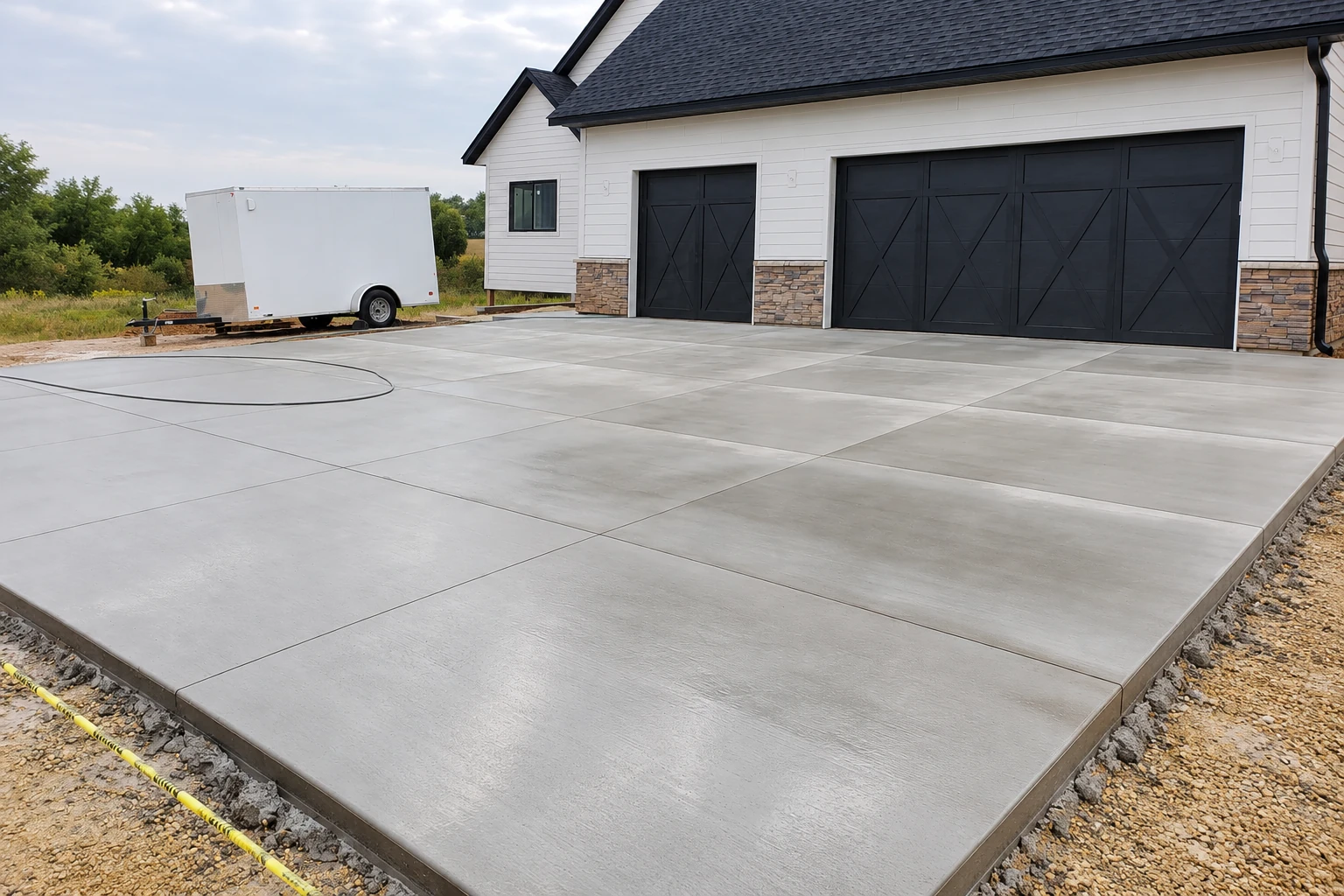
Concrete floor installation in Fremont means we prepare the ground, lay a moisture barrier where the floor needs one and pour a concrete slab that becomes the floor of your basement, shop, outbuilding or addition once it cures.
Most people who call me have a space they can't use yet. It might be a dirt or gravel floor in an outbuilding, an old slab that has cracked and dropped, or an addition waiting on its floor. The price mostly turns on the size of the room, how much digging and base work the ground needs, which barrier goes under the slab, the finish on top and how easily we can get concrete to the spot. The schedule turns on the weather, any permit and inspection, and the cure before your flooring can go down. When I come out, the written estimate puts your own figure on all of that.
How do you know it's time for a new concrete floor?
Dirt or gravel underfoot
A dirt or gravel floor in a shed, shop or basement tracks dust and holds damp, and it limits what the space can be used for. The longer it stays that way, the more you work around the room instead of using it.
Cracked, sunken or uneven slab
An old floor that has cracked and dropped in spots usually sat on a base that was raked level instead of dug out and packed, so it settled with the dirt. Patching rarely holds while the ground under it is still moving, and the trip edges tend to get worse.
Damp spots or lifting flooring
Dark patches, a musty smell or flooring that curls and lets go usually mean moisture is coming up through the slab. Leaving it tends to ruin each new covering you put down and can bring on mold.
How we handle concrete floor installation
The first thing I ask is what will go on top of the floor, because tile, wood, carpet, a coating or bare concrete each change how we keep moisture from coming up through it. Then our crew digs out and packs the subgrade, the ground the slab sits on, so the floor doesn't sink with the dirt underneath. We check where water runs around the space, lay the barrier that suits your covering, set rebar, the steel that helps hold the slab together, and plan the pour for the cooler part of the day so the top doesn't end up weak and dusty. After finishing, we cut control joints, shallow lines that give the slab a place to crack where we choose, and let the floor cure, the slow hardening that gives concrete its strength. If the budget is tight, I'd rather spend it on the base than on a fancier finish, since you can redo a surface later but not the ground under it.
A floor is often one part of a bigger project. If the new space opens onto a pool, we also build concrete pool decks, and when a door sits above the ground we can pour concrete steps during the same job so the entry is done along with the floor.
Smooth floor for a covering
A steel-troweled surface suits tile, wood, carpet or a coating, because those need a flat, tight top to bond to and lie on. This is also where the moisture barrier matters most, since a covering traps whatever comes up from below.
Broom finish for work spaces
A broom finish, fine lines dragged across the wet surface, gives grip in a shop, utility room or outbuilding that will stay bare concrete. It suits a floor you'll be working on when it gets wet or dusty.
Get a written estimate for your new concrete floor
We reply within one business day to set a time. I come out, look at the space and write up a free estimate, and there's no pressure to book.
(402) 512-8158- Based in
- Fremont, NE 68025
- Hours
- Mon–Sun: 8 AM–9 PM
What happens after you call about a concrete floor?
Here's how a floor job runs with us, from the first conversation to the walk-through once the slab is done.
Set a time to visit
When you call, I set a time to come out to the property. I'll ask a few questions about the space first so the visit is useful.
Look at the space together
I look at the job, listen to what you have in mind and check the ground and drainage around it. You then get a written estimate that lays out the work and the price, so nothing is a guess before you decide.
Handle permits and pour the floor
Once you're ready, we take care of any permits, pick a pour date with the weather in mind and do the work with our own crew while I check it on site. In Fremont, work that needs a permit stays open and visible until the building official approves it, so we don't pour over anything the inspector still has to see.
Walk the finished floor together
When we finish, I walk the job with you and go over how to look after the floor while it cures. Thank you for having us is usually how that visit ends, and I mean it.
Why Fremont homeowners call Fremont Concrete for floors
I write your estimate myself
I come out to look at the job, write the estimate and answer my own phone, and our own crew does the pour while I'm on site checking it. You deal with the person responsible for the floor from the first call to the last day.
Learned on a Fremont crew
I learned the trade on a Fremont finishing crew before starting this business in 2017. I came to concrete later than most, which is part of why I explain each step instead of asking you to take it on trust.
Licensed and fully insured work
We're licensed and fully insured. That matters on a floor inside your building, where the crew, the equipment and your property are all close together.
Straight talk before you book
If a new floor isn't what your space needs, I'll tell you so, even when that means a smaller job. When I don't know the answer to something, I'll find out rather than guess.
On a floor, the base and the moisture barrier decide how it holds up, so that's where I start. When you're ready, send us the details or call (402) 512-8158.
Concrete floors and permits in Fremont
The city's building official issues permits to build, alter or repair buildings, and the city's list of work that needs no permit names painting, tiling and carpeting, not concrete floors. So I don't treat a floor as exempt. When our work needs a permit, we handle the application and book the inspections for our part of the job, and if I'm not sure what the city's building permits and inspections office asks for, I check with them before we start. Fremont also asks contractors working for hire on permitted projects in the city and the two miles around it to register with the city, and the state asks contractors to register with the Nebraska Department of Labor, which says plainly that registration isn't a promise of good work.
Radon is worth thinking about before the slab goes in, because the barrier is easiest to choose now. Nebraska's health department has found homes with high radon in every county with test results and says every home should be tested, wherever it is. One barrier maker says its EVOH barriers, built in layers around a special core, resist gases far better and are nearly impermeable to radon, and I'll talk with you about whether that kind suits your floor. We have the same conversation on basement and shop floors in Blair and Schuyler.
Questions about concrete floors in Fremont
How much does a new concrete floor cost in Fremont NE?
The price of a concrete floor is set mainly by its size, how much digging and base work the ground needs, which barrier goes under it and the finish on top. Getting concrete into a building, a winter pour that needs protection or a gas-resistant barrier each add to it, while a plain broom finish keeps it lower. I'll give you a written figure after I see the space.
Does a concrete floor need a permit in Fremont?
Plan on asking the city, because concrete floors aren't on its list of work that can skip a permit, and we check before we start. If you live in the house and do the work yourself, the city says you can, but you still need the permit.
How long does a new concrete floor take to cure before I can walk on it?
A new slab should be walkable within 48 hours, but concrete takes a month to fully cure. To be safe, wait a week before moving heavier things back in, and plan your flooring and move-in dates around that month.
Will my new concrete floor crack?
It may show a few fine cracks, and that's normal, because a national guide to concrete floors says that even with the best design and proper construction, a completely crack-free and curl-free floor isn't realistic. I'll tell you that up front, and the control joints we cut give most cracking a place to go, which is worth keeping in mind when you pick a finish.
Can a concrete floor be poured in cold weather?
Yes, it can, as long as the fresh concrete is protected from the cold. National guidance counts a pour as cold weather work when the air has dropped to 40°F, or is expected to drop below it, while the new concrete is being protected. We pick the pour date with the weather in mind and will tell you how we'll protect the slab or whether it's better to wait.
What is the best way to keep moisture from coming up through a concrete floor?
A properly installed vapor retarder, a moisture barrier laid under the slab, cuts down or stops moisture moving up into the room. That moisture can ruin floor coverings and coatings and lead to mold and mildew, so the barrier matters most when tile, wood, carpet or a coating will go on top.
Concrete work that often goes with a floor
Concrete pool decks
When the space you're finishing opens onto a pool, a concrete deck gives the area around the water a firm surface with a finish chosen for grip.
Concrete steps construction
A door that sits above the ground needs a safe way in, and poured concrete steps can be built to match the height of your new floor.
Fremont, NE
Plan your new concrete floor with us
If you can tell us the room's size and the covering you have in mind, I can come out ready to talk through the barrier, the finish and a pour date.